
CEEC grain update
-Monday, May 29, 2001
This analysis featured in the May 29, 2001 issue of the HGCA's MI Prospect, Volume 3, Number 23
The grain situation in central and eastern European countries (CEEC) is of current interest as most of them are moving towards membership of the EU. Being geographically close to the EU they are natural trading partners. And, although the region is not a big participant in the world market, it has in recent years been a rather erratic producer showing up on both sides of the market. With the world supply situation, particularly for wheat, tighter CEEC production could have an impact on the international market next season.
Key Points
- CEEC are usually net exporters
- With a poor harvest, they have been net importers this year
- More normal crop conditions are returning
- CEEC could manage a low level of net exports next season.
The CEEC countries
Four of the countries, Poland, Romania, Yugoslavia and Hungary, typically account for 80 percent of production, individually producing about 30, 20, 15 and 15 percent of the total. A typical CEEC crop is about 80 to 90 million tonnes, about 40 percent of a EU crop.
Poland is the largest producer of wheat, barley, oats and rye in the region. Romania, Yugoslavia and Hungary are more reliant on spring seeded maize, although all three are significant wheat producers(Chart 1).
continue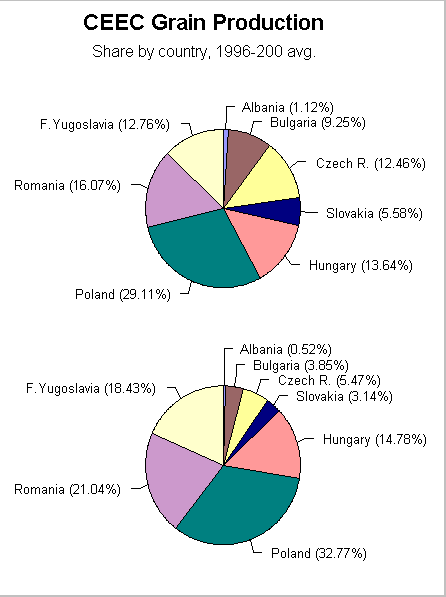
Note: Upper pie wheat, lower pie coarse grain.
Source: USDA
continued
Despite being the largest grain producer in the region Poland is also the largest importer of both wheat and coarse grains. When the CEEC have short crops, they have in recent years tended to source much of their import needs from the EU.
The CEEC provide an occasional and usually modest market for British grain. This crop year to February the UK had exported about 54,000 tonnes of wheat to Poland and about 25,000 tonnes of barley to Poland, Hungary and the Czech Republic combined by the end of Feburary. This is the first grain exported by the UK to the CEEC in four years. But an exceptional 309,000 tonnes of wheat was exported to Poland in 1996/97.
The former Yugoslavia has also been a consistently importer of significant quantities of wheat in recent years, undoubtedly as a result of the impact on civil unrest on farming in the region.
Hungary is the largest net exporter with Romania also a fairly consistent net exporter. Both countries export both wheat and maize but in total they rarely exceed a couple of million tonnes.
CEEC production prospects
In recent years and since the demise of central planning, the CEEC have been increasingly erratic producers of grain, in years of better crops exporting significant quantities of wheat and corn and in others resorting to imports(Chart 2).
continue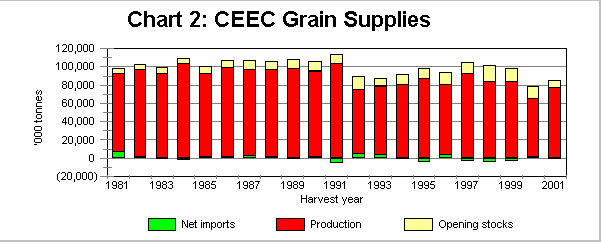
Source: USDA
continued
Harvested areas have declined by about 10 percent over the last ten years with only Poland escaping this trend. Yields, however, are erratic ranging 20 percent either side of averages. Last year's yields were at the lower end of the range.
CEEC production this and next season
Thus, last year was a particularly poor production year for the CEEC with output of spring seeded coarse grain reduced by a third by a summer drought with the mainly winter seeded wheat harvest being reduced by about ten percent. After net exports of more than 2.5 million tonnes of grain in 1999-2000, the CEEC are expected to record net imports of 1.7 million this crop year. Further, feed grain consumption in the eight countries was reduced by 20 percent.
While it is certainly too early to assess final production this year, it is evident that the CEEC have some way to go to rebuild domestic consumption and year end stocks before becoming a major exporter, even if they are favoured with better crop development weather. Conversely, if they suffer another poor year, they will be more dependent on imports as they will have very limited latitude to draw down domestic consumption of feed grain and carryover stocks.
This spring, winter crops in southern areas broke dormancy in below average condition with soil moisture reserves still a concern after last year's drought. Those in northern areas were assessed to be in better condition. In late April, however, the southern areas received above average rainfall. Concern over CEEC crops now appears to relate as much to the delay in development of winter crops resulting from the earlier dry and cool weather as to soil moisture.
With average crop development conditions for the balance of spring and summer a reasonable but not exceptional harvest can be expected. The implication of this might be lower than usual exports with some replenishment of depleted stocks and increase feed grain consumption to be expected.
In its first 2001-02 world supply and demand projection the United States Department of Agriculture puts Eastern European production higher than last year with some increase in domestic consumption and stocks, and net exports of 1.1 million tonnes, about a third of levels that might be expected in a normal year.
As for almost anywhere, but particularly for the CEEC, crop development conditions will need watching and could produce results on either side of this scenario. CEEC crops are difficult to forecast. In 1997 the 93 million tonne crop was initially forecasted at 83 million tonnes in the spring. Whereas last year''s crop of 65 million tonnes was initially forecasted at 86 million tonnes.
Caution is also necessary as the CEEC have not produced a crop as small as last year's since the early 1970's and well before central planning was abandoned. There is, therefore, little experience for assessing how the market will allocate increased supplies after such a short crop.
David Walker 01603 705153
top of page